


Figure 4
Télécharger l'image originale
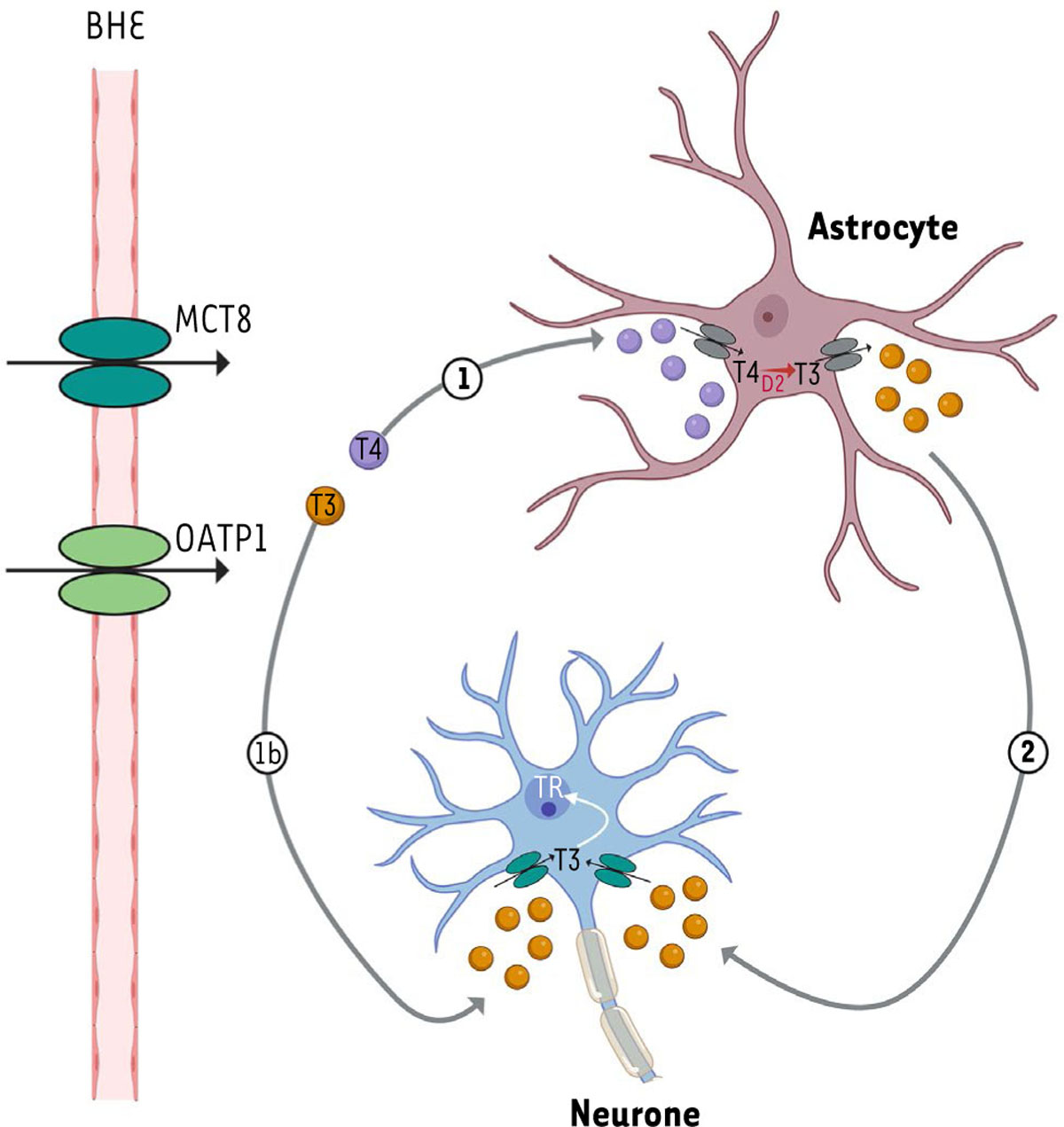
Modèle proposé de l’interaction astrocyte-neurone et du transport de la T3 dans le cerveau. Tout d’abord l’hormone T4 (et à moindre mesure l’hormone T3) traverse la barrière hémato-encéphalique (BHE) grâce aux transporteurs OATP1 (organic anion transporting polypeptide 1) et MCT8 (monocarboxylate transporter 8). Trois scénarios sont possibles pour la suite : 1. L’hormone T4 est transportée dans les astrocytes par un transporteur encore inconnu. Dans les astrocytes, l’hormone T4 est convertie en T3 par l’enzyme D2. L’hormone T3 biologiquement active est ensuite transportée hors des astrocytes par un autre transporteur inconnu. 1b. L’hormone T3 depuis la BHE rejoint les neurones par MCT8. 2. L’assimilation neuronale de l’hormone T4 métabolisée en T3 par les astrocytes est facilitée par MCT8 puis l’hormone T3 exerce son action génomique en se liant à son récepteur nucléaire (TR).
Current usage metrics show cumulative count of Article Views (full-text article views including HTML views, PDF and ePub downloads, according to the available data) and Abstracts Views on Vision4Press platform.
Data correspond to usage on the plateform after 2015. The current usage metrics is available 48-96 hours after online publication and is updated daily on week days.
Initial download of the metrics may take a while.