


Figure 1.
Télécharger l'image originale
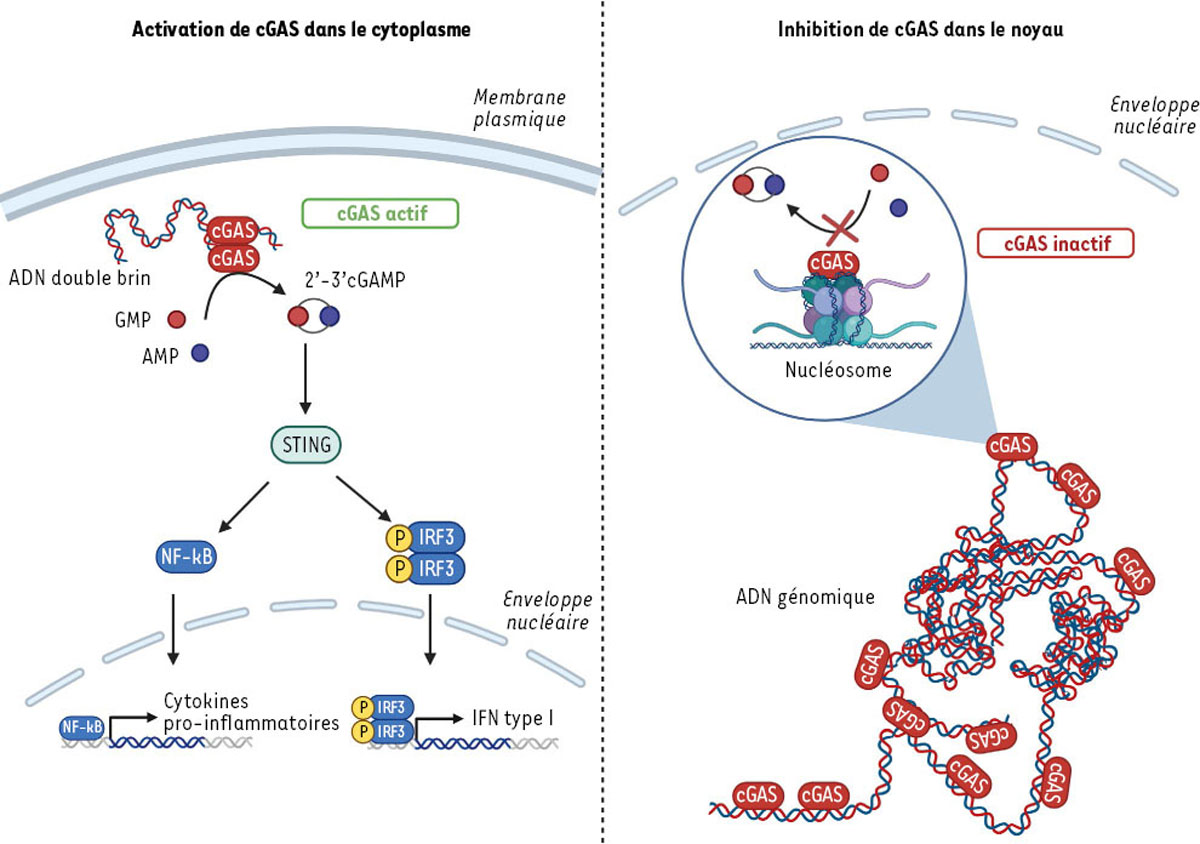
Activation cytoplasmique et inhibition nucléaire de cGAS. Dans le cytoplasme (à gauche), la détection d’ADN double brin par la protéine cGAS conduit à sa dimérisation et à la production du second messager 2’-3’ cGAMP. Cela entraîne l’activation de STING et la translocation nucléaire de NF-kB et de dimères IRF3 phosphorylés, conduisant à la production de cytokines pro-inflammatoires et d’interféron (IFN) de type I. Dans le noyau (à droite), cGAS est fortement liée au nucléosome, ce qui empêche sa dimérisation. Elle est ainsi maintenue dans un état inactif sur l’ADN génomique. Figure réalisée avec BioRender.
Current usage metrics show cumulative count of Article Views (full-text article views including HTML views, PDF and ePub downloads, according to the available data) and Abstracts Views on Vision4Press platform.
Data correspond to usage on the plateform after 2015. The current usage metrics is available 48-96 hours after online publication and is updated daily on week days.
Initial download of the metrics may take a while.